01
Create a project
Name the area, pick a folder, and set the design template: drop length, hub spacing, optics reach, cable sizes, and duct.
The smartest Fiber Designer on your team
Sites, roads, and On The Way homes in. A contiguous route, hubs, OLTs, a splice plan, and a bill of materials out. Bedrock, railroads, waterways, and interstates are counted for the permit packet.
The homepage is public. The designer and the sample project require an account.
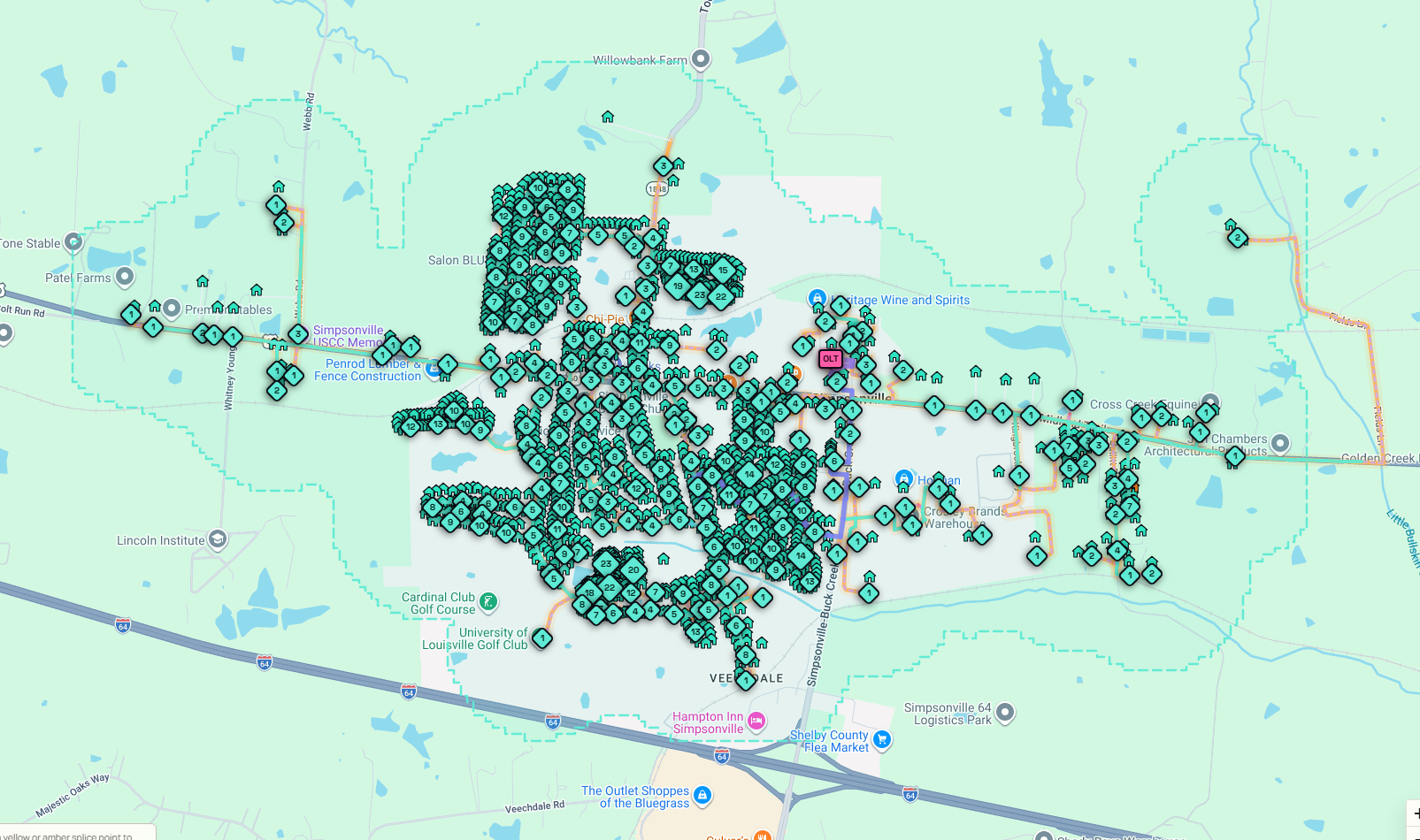
Simpsonville, KY. Sign in to open the design.
01
Name the area, pick a folder, and set the design template: drop length, hub spacing, optics reach, cable sizes, and duct.
02
Sites and On The Way locations as GeoJSON or GeoPackage. Roads as GeoJSON. Middle-mile leases if a carrier is already in the ground.
03
One run builds the fiber, hubs, drops, and OLTs. Turn on the splice plan for feeder cables, hub tails, and the colour matrix.
04
Export the design and the bill of materials: construction miles, bedrock depth, railroad, waterway, and interstate crossings.
The standard design locks the fiber and the OLTs. On The Way adds homes without moving either, and you pick which design to keep.
Drops land on the fiber, not the nearest vertex. Hubs are spaced from the homes they serve. A site past the drop limit stays on the map, marked.
Cable from 12 to 384 count, conduit by size, construction miles counted once where ducts share a trench, handholes, slack, and OLT ports.
Bedrock depth from USGS, binned so you see shallow rock. Railroad crossings by operator. Waterways and interstates counted the same way.
Lease a carrier's fiber where it is cheaper than building. Set a price per foot and a minimum span. The design leaves for its own fiber when that wins.
Keep several versions of a project. Assign a folder to a company and every project in it inherits that company.
Run the served locations first. Then, if you want them, add On The Way homes on the same fiber and the same OLTs. Switch between the two bills of materials without designing the network twice.